Static Analysis in CI: Build a Useful Secure Code Review Workflow
Static application security testing (SAST) examines source code or compiled representations to find patterns associated with vulnerabilities. It can detect issues early and consistently, but it does not prove that a program is secure. A scanner may miss a vulnerability because it lacks context or produces a false positive because a pattern is harmless in the application. The workflow should help engineers resolve meaningful risks rather than turn every alert into noise.
Begin by deciding which code, languages, repositories, and pull-request events need coverage. Inventory production services and shared libraries first. A scanner that runs only on the default branch may find issues after merge but fail to give authors feedback before release. Conversely, running a slow full analysis on every trivial change can frustrate teams and encourage bypasses. Choose a schedule that provides useful feedback without weakening required controls.
Choose and configure the analysis scope
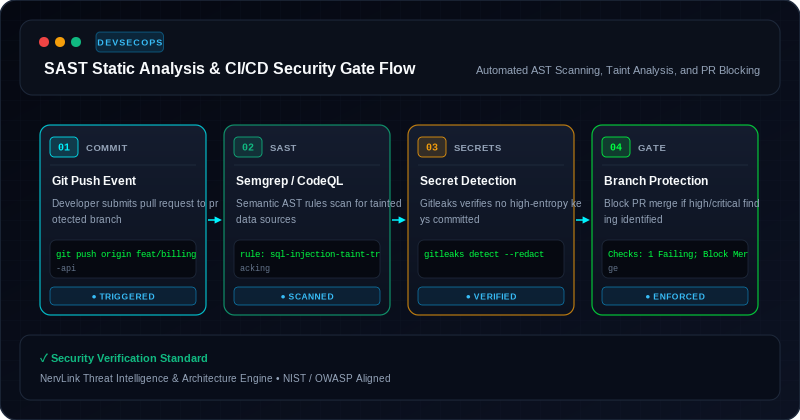
Select tools that support the languages and frameworks in the application. Review what the default rules cover, which query suites can be enabled, how sources and sinks are modeled, and whether the tool analyzes dependencies or only first-party code. GitHub CodeQL provides maintained query suites with different precision and coverage tradeoffs; broader suites can find more issues and may also produce more lower-confidence results.
Configure exclusions carefully. Generated files, vendored code, and test fixtures may need different treatment, but broad path exclusions can hide real application code. Keep exclusion reasons documented and reviewed. Add custom queries only when the organization can maintain and validate them. Every custom rule should include test cases for the intended finding and common safe patterns to limit noise.
Make findings actionable for developers
Show the affected code path, why it matters, and a practical remediation. Group duplicate findings and connect them to a CWE or security category when the tool supports it. Prioritize issues based on exploitability, reachability, data sensitivity, exposure, and business impact instead of severity labels alone. Provide examples of safe APIs or patterns in internal documentation.
Define triage states and ownership. An alert can be confirmed, fixed, mitigated, not applicable, or accepted temporarily with a rationale and review date. Suppressions should be narrow and attributable; do not disable an entire rule because one case is safe. Revisit suppressions as code changes, since a previous justification may no longer apply after a refactor.
Set policies for pull-request gates based on signal quality. High-confidence, reachable critical issues may block merge. Lower-confidence findings can be reported for review while teams improve rule precision. Avoid treating scanner output as a substitute for human code review, architecture analysis, or runtime testing. A clean scan only says the configured rules did not report a finding under their analysis assumptions.
Protect the pipeline and its permissions
Scanner workflows process source code and sometimes execute build steps. Restrict workflow token permissions, protect configuration files, and avoid exposing secrets to untrusted pull-request code. Pin third-party actions and review updates. If analysis requires dependencies, install them from controlled sources and consider the risk of executing package scripts. Keep code scanning credentials separate from deployment permissions.
Ensure the analysis result corresponds to the commit being reviewed. Record the commit SHA and tool configuration, and make sure required checks cannot be bypassed by a stale result from a different revision. For monorepos, confirm that changes to shared libraries trigger scans of affected products or component builds. Protect artifact and cache boundaries where analysis jobs share data with deployment jobs.
Measure signal and improve over time
Track time to triage, time to fix, reopened findings, false-positive rate, aging exceptions, and coverage of critical repositories. Avoid measuring success by the number of alerts closed or scans executed. A sudden drop in findings may indicate better code—or a broken workflow, changed scope, or disabled queries. Review scanner upgrades and configuration changes like other production changes.
Use representative seeded examples to confirm detection still works after tool updates. Include vulnerable and fixed patterns in a safe test repository or controlled fixtures. Review results with developers and security engineers, adjust custom sources and sinks, and document known limitations. Combine SAST with dependency analysis, secret scanning, dynamic testing, and manual review; each finds different classes of issues.
A practical implementation sequence
Start with a pilot on one supported, high-value repository. Establish a baseline, triage the existing backlog, configure pull-request feedback, and identify high-confidence blocking rules. Give developers a short remediation guide and a clear path to ask about findings. Expand to more repositories after observing scan duration, result quality, and maintenance cost. Keep the configuration as code and review changes through the same protected workflow as application code.
For each high-risk finding, validate whether the flagged data flow is reachable and whether a mitigation is present. Fix the code, add a regression test when practical, and confirm the alert closes on the new commit. For a false positive, preserve the reasoning and create a narrowly scoped suppression. This creates a traceable improvement loop rather than an accumulating dashboard of unowned warnings.
Secure code scanning checklist
Cover critical code and languages; configure the right query suite; review exclusions; protect scanner workflows; keep findings tied to the exact commit; triage by context; make suppressions narrow and expiring; seed tests for detection; measure coverage and signal quality; and combine static analysis with other controls. Assign an owner for tool configuration and update rules as the application evolves.
Static analysis is most valuable when developers trust its feedback and understand how to act on it. Tune for useful signal, secure the pipeline that produces results, and verify findings in context. Treat the scanner as an engineering aid within a secure development process, not as a certificate that code is safe.
References
- GitHub Docs: CodeQL query suites
- GitHub Docs: Code scanning setup types
- NIST SP 800-218: Secure Software Development Framework