Container Image Signature Verification: Trust the Digest You Deploy
A container registry can host images built by many repositories, workflows, and people. A tag such as release or latest is a mutable name; it does not prove who built the image or whether its contents changed. Signature verification can help a deployment system confirm that an image digest is associated with an approved identity or signing key. The policy must check the identity and artifact claims that matter, or a valid signature from the wrong source can still be accepted.
Image signing is one part of software supply-chain security. It can provide evidence that a particular signer attested to an immutable digest, but it does not prove that the source code is safe, the build environment was uncompromised, or the resulting image is free from vulnerabilities. Pair signatures with protected build workflows, provenance, dependency controls, and runtime policy.
Identify the artifact by digest
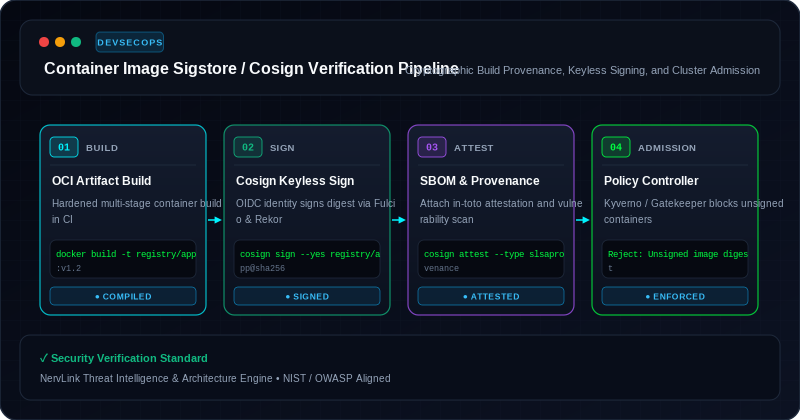
Use an immutable image digest as the deployment reference after testing and promotion. A digest identifies the image manifest content, whereas a tag can be moved to another digest. Record the digest that passed scanning and release checks, and ensure the deployment system uses that same digest. If a tag is used for user convenience, resolve it to the approved digest and prevent it from changing during promotion.
Make sure signing and verification refer to the expected repository and artifact type. Image indexes can refer to multiple platform-specific manifests; verify the correct digest and understand which platform image will run. Preserve build metadata and attestations with the release record so responders can trace the deployed artifact to its source revision and build workflow.
Define a verifier identity policy
With key-based signing, securely distribute the verification key and rotate it with a documented process. With keyless signing, verification can use a certificate identity and an OIDC issuer. In either case, configure the verifier to expect the precise identity that should sign production images, such as a protected repository workflow and release context. Do not accept any signature in a public transparency log as sufficient authorization.
Separate policies by environment and trust level. A development image should not automatically satisfy a production policy. Restrict who can change verification rules, and require review for exceptions. A signature from a compromised or overly broad workflow may be cryptographically valid while still failing the organization's intended trust policy.
Verify before deployment, not after
Enforce signature checks in the deployment admission layer or release pipeline before a container starts. Fail closed for images that lack the expected signature or whose identity does not match policy, while providing an audited exception path for emergency response. Test rejection behavior with an unsigned image, an image signed by the wrong identity, a modified digest, and a valid approved artifact.
Verification should be reproducible. Capture the verifier version, policy configuration, identity constraints, and result alongside the deployment record. Avoid relying on an administrator's local CLI check that is not connected to the production admission path. If images are mirrored between registries, test whether signatures and attestations are copied and whether the destination digest remains identical.
Protect the signing workflow
If the signing job can be modified by untrusted pull-request code, attackers may be able to produce an approved signature for malicious content. Protect workflow files, restrict token permissions, pin third-party actions, and separate untrusted build jobs from production signing. Use short-lived identity federation where practical and avoid long-lived signing secrets in general CI contexts.
Build provenance can strengthen the evidence by describing the source and process that produced an artifact. Verify the expected repository, revision, builder identity, and build parameters. Provenance is only as trustworthy as its producer and verification policy. Build isolation, dependency pinning, and protected release controls remain necessary to prevent a compromised dependency or runner from creating misleading evidence.
Include scanning and response in the policy
Signature verification does not replace vulnerability scanning. Scan the digest that will be deployed, track its SBOM and source revision, and apply risk-based policy for findings. Decide how to handle newly disclosed vulnerabilities after an image is already running: block new deployments, rebuild and sign a fixed image, and prioritize redeployment based on exposure and impact.
During an incident, identify all environments running the affected digest. The signature and provenance record can help find the build workflow and source revision. Revoke trust in a compromised signer or workflow, prevent further deployment of affected artifacts, and rebuild from a clean process. Preserve the old digest and evidence for investigation rather than silently overwriting the tag.
Roll out with observable enforcement
Begin with audit-only evaluation across representative workloads, record which images would be rejected, and fix missing signatures or identity mismatches. Move to enforcement for a pilot namespace or environment, then expand. Track unsigned images, policy exceptions, verification latency, and blocked deployments. Make the policy error explain which identity or evidence is missing without exposing sensitive data.
Document how developers sign test and release images, how platform teams update trusted identities, how signatures are mirrored, and how emergency exceptions expire. Test the workflow whenever the registry, builder, identity provider, or deployment platform changes. Periodically verify that running workloads still correspond to approved digests.
Deployment checklist
Promote by digest; define the accepted signer identities; protect build and signing workflows; verify images before execution; validate provenance and scan results; retain deployment evidence; test rejection cases; monitor exceptions; and rehearse signer compromise. Make verification policy part of version-controlled infrastructure and protect changes to it.
Image signatures make trust decisions more explicit and automatable. Their value comes from connecting an immutable artifact to a narrowly authorized identity and enforcing that decision where deployment happens. Treat verification as one control in a wider build and release security program, not as a standalone assurance badge.
References
- Sigstore Cosign: Verifying signatures
- Docker Build: Attestations
- NIST SP 800-204D: Software supply chain security in CI/CD