SBOM Vulnerability Management: From Component List to Response Plan
A software bill of materials (SBOM) is a formal record of the components in a software product and their relationships. It can help teams answer a practical question during a vulnerability disclosure: which shipped products contain the affected library, and where are those products deployed? An SBOM is valuable when it is accurate, tied to a particular build, refreshed as software changes, and connected to an owner who can assess and remediate findings.
An SBOM is not a security certification, a guarantee that code is vulnerability-free, or a replacement for dependency management. It describes known composition. The organization still needs a process to match components to advisories, determine whether the affected code is present or reachable, prioritize risk, and deliver a fix. A stale or detached SBOM may create false confidence because it describes a source branch or prior release rather than the artifact operating in production.
Generate the inventory from the release artifact
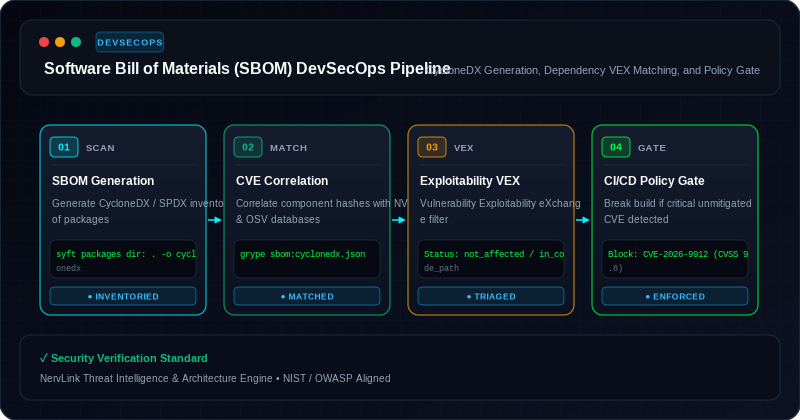
Generate an SBOM as part of a controlled build or release process and associate it with an immutable artifact digest, version, build identifier, and source revision. Include direct and transitive dependencies, operating-system packages, runtime components, and bundled libraries where the tooling can identify them. Document known blind spots, such as dynamically downloaded modules, vendored source, or components embedded in opaque binaries.
Use a maintained format and validate its schema before publication. Formats such as SPDX and CycloneDX represent component identity and relationships in different ways; choose one based on tooling interoperability and the information consumers need. A useful record should identify package names and versions consistently enough to compare against vulnerability advisories. Include supplier, origin, and licensing fields when available, but avoid inventing values for unknown components.
Protect the SBOM as part of the release record. Publish it next to the artifact or in a trusted metadata store and ensure it cannot be silently replaced after release. Where supported, sign or attest the relationship between the SBOM and the artifact. Consumers should be able to verify which image or package the inventory describes rather than trusting a filename or mutable tag.
Normalize component identity before matching advisories
Vulnerability matching is difficult because ecosystems use different naming conventions, version rules, forks, and package aliases. Record ecosystem-specific identifiers and package URLs where supported. Preserve enough context to distinguish a vendor backport from an upstream version, and keep source repository or supplier information when it clarifies identity. A version string alone may not prove that a component is affected or fixed.
Ingest advisories from credible sources and match them to the SBOM inventory. Enrich findings with the affected version range, fixed version, severity information, exploit status if known, and the release or service where the component is used. Do not treat a scanner's “not vulnerable” result as conclusive when the component identity or vendor patch status is ambiguous. Route uncertain matches for human review with evidence attached.
Prioritize for real product risk
Prioritize a finding using more than the CVSS number. Consider whether the component is present in a deployed artifact, whether the vulnerable code path is reachable, whether the product is exposed to an attacker, the impact of exploitation, availability of a fix or mitigation, and the business importance of the affected service. A critical vulnerability in an unused build tool may require a different response from a remotely exploitable library in a public service, though both deserve documented decisions.
Define response deadlines by risk and exposure. Assign each finding an accountable product owner, technical remediation owner, due date, and state. The workflow should distinguish “not affected,” “fixed,” “mitigated,” “accepted with expiry,” and “under investigation.” Require evidence for closure: updated SBOM and artifact digest, a test result, a vendor advisory, or a documented reachability analysis. Exceptions should expire and be reviewed.
Use the inventory during incident response
When a new vulnerability is announced, query the inventory for affected package identities and versions. Map matches to deployed services, environments, owners, and business processes. Confirm whether the affected version is actually present in the production artifact; development manifests alone do not establish that. If exposure is plausible, use the organization's incident process to assess mitigations, patch availability, and compensating controls.
Track remediation through the release pipeline. Produce a new artifact, generate a new SBOM, test the change, and verify that the deployed digest corresponds to the updated inventory. If a mitigation is temporary, record what condition permits removal and how the team will detect a regression. Communicate status to product and security stakeholders using affected products and exposure, not only a count of package findings.
Make the process measurable and maintainable
Measure inventory coverage for shipped products, freshness of SBOMs, time from advisory publication to triage, time to remediation by severity, and the number and age of accepted exceptions. These metrics reveal process gaps better than the raw number of vulnerabilities alone. Test the process with a tabletop scenario: introduce a known vulnerable package in a staging build, confirm that the SBOM captures it, simulate an advisory, and follow the finding to a fixed release.
Protect build systems and provenance. A compromised pipeline can produce an inaccurate inventory, so SBOM generation should use the same controlled inputs and integrity checks as the artifact. Keep records accessible during incidents, including when the source registry or build service is unavailable. Provide consumers with a stable path to retrieve the SBOM for each supported release and explain what the inventory includes.
Operational checklist
Generate the inventory from the exact release artifact; identify direct and transitive components; record immutable build and source identifiers; validate the format; preserve and verify the artifact-to-SBOM relationship; match advisories using ecosystem-aware identities; prioritize by deployment and exploit context; assign owners and expiry-based exceptions; and verify remediation with a new artifact and inventory. Periodically test the end-to-end process.
An SBOM becomes operationally useful when it shortens the path from an advisory to an informed product decision. Build it into release engineering, connect it to ownership and deployment records, and keep it synchronized with the artifacts that customers and services actually use.
References
- NIST CSRC: SBOM definition
- NIST SP 800-218: Secure Software Development Framework
- NIST SP 800-204D: Software supply chain security in DevSecOps CI/CD