Secure Session Cookies: Rotation, Expiry, and Logout Checks
A session cookie is a bearer credential: anyone who obtains a valid session identifier may be able to act as the user until the server expires or revokes it. HttpOnly and Secure are important cookie attributes, but they do not make a stolen session harmless, fix missing authorization checks, or invalidate a session after logout. Session security comes from the whole lifecycle: creation, rotation, storage, idle and absolute expiration, revocation, and recovery.
This guide focuses on server-managed web sessions. Token-based architectures have different implementation details, but they still need defined lifetimes, revocation or rotation behavior, and protection from theft. Choose a model based on the application and threat model rather than assuming that a self-contained token is automatically safer than a server-side session.
Generate and store an opaque identifier
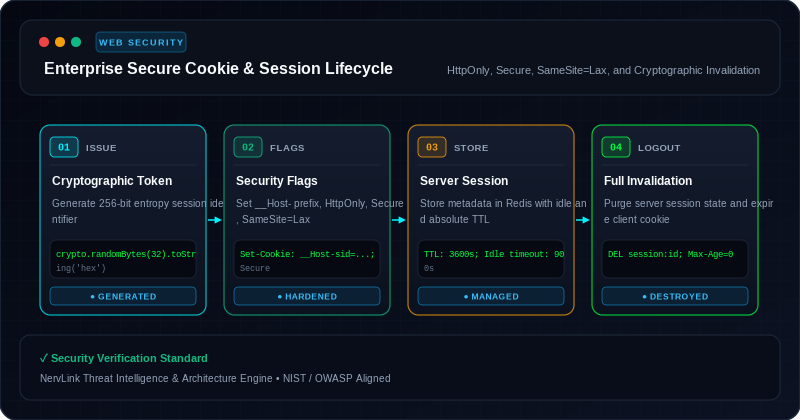
The cookie value should be an unpredictable identifier with sufficient entropy, generated by a cryptographically secure random number generator. Do not embed user IDs, roles, email addresses, or other business data in a session ID. The server maps the opaque value to session state in a protected store. A client can read, copy, or replay its own cookie, so changing fields inside a cookie is not a substitute for server-side authorization.
Store session state with access controls and retention limits. If the session store is a database, avoid logging complete cookie values in queries or diagnostics. Where practical, store a one-way verifier of the random identifier and compare it safely when looking up the session. A hashed session lookup reduces the value of a read-only database exposure, but it does not protect against a compromised application that can accept stolen cookies.
Set attributes for the application boundary
For an HTTPS application, set Secure so the browser does not send the cookie over cleartext HTTP and HttpOnly so client-side JavaScript cannot read it directly. Choose SameSite deliberately based on whether cross-site navigation or identity-provider callbacks need the cookie. Strict may interrupt expected flows; Lax is often compatible with top-level navigations; None requires Secure and should be used only when cross-site use is necessary.
Restrict Domain and Path to the smallest scope the application needs. Omitting Domain creates a host-only cookie, which can prevent sibling subdomains from receiving it. Use the __Host- prefix where compatible: it requires Secure, Path=/, and no Domain attribute, reducing some cookie shadowing risks. Do not assume Path is a security boundary between mutually untrusted applications on the same host.
Avoid setting a persistent Max-Age or Expires for a session cookie unless “remember me” is an intentional, separately protected product feature. Browser closure is not a reliable logout event because session restore may retain cookies. Server-side idle and absolute expiration must remain authoritative.
Rotate after authentication and privilege changes
Session fixation occurs when a pre-authentication identifier remains valid after the user authenticates. Issue a new session identifier after login and invalidate the old one. Rotate again after privilege elevation, account recovery, or other sensitive authentication transitions. The application should not accept the old identifier after rotation. Do not rotate on every ordinary request if it creates race conditions across tabs or makes concurrent requests unreliable; define rotation events and test them.
For a privilege change, create a new session with only the intended state, revoke the old session, and record the reason. Test concurrent requests so an older response cannot reset the browser to a revoked ID. If the application uses a distributed session store, ensure revocation reaches all instances quickly enough for the product's risk tolerance.
Define idle and absolute timeouts on the server
An idle timeout ends a session after a period without meaningful user activity. An absolute timeout limits total session age even if activity continues. High-risk workflows may need reauthentication after a shorter interval or before a sensitive action. The exact values depend on data sensitivity, device context, user experience, and regulatory requirements. Define them in policy and enforce them in server-side session checks; a client-side countdown is only a user-interface aid.
When a session expires, revoke its server-side state and clear the cookie using the same name, path, and domain scope used when setting it. Removing the browser cookie alone does not invalidate a copied identifier. Logout should revoke the server session, clear the cookie, and handle related refresh credentials. Provide an account security view to revoke other sessions when the service supports multiple devices.
Protect state-changing requests separately
Cookies are automatically attached by browsers according to their scope and site rules. A malicious page may be able to trigger a state-changing request even when it cannot read the response. Use CSRF defenses that fit the framework, such as anti-CSRF tokens or carefully designed same-origin checks, and require authorization on every operation. SameSite is useful defense in depth but should not be treated as the only CSRF control in all application flows.
Avoid putting session IDs in URLs, logs, referrer-bearing links, or analytics events. URLs are copied into browser history, proxies, monitoring, and screenshots. Never place session identifiers in local storage for convenience if an HttpOnly cookie is appropriate. A cookie accessible to JavaScript can be stolen through injected script; an HttpOnly cookie reduces direct access but still requires XSS prevention because injected code may issue authenticated requests.
Test the lifecycle and replay behavior
Use two test accounts and inspect cookie attributes in browser developer tools and automated HTTP tests. Confirm that authentication changes the session ID, the pre-authentication ID fails afterward, logout invalidates the server-side session, and idle and absolute expiration work. Test that a revoked session fails on every API instance. For multi-tab behavior, ensure one tab's refresh does not silently restore a logged-out session.
Test sensitive actions with expired, revoked, malformed, and missing cookies. Confirm that authorization is checked even when a request includes a valid session. Redact cookie values in test output and logs. Use synthetic accounts and disposable sessions; never paste real session tokens into a report or ticket.
Review checklist
- Is the cookie an opaque, unpredictable identifier with server-side session state?
- Are
Secure,HttpOnly, and the intendedSameSitepolicy set? - Are host, path, and domain scope as narrow as the application allows?
- Does the server rotate identifiers after login and privilege changes?
- Are idle and absolute expiry checked server-side, with server revocation on logout?
- Are state-changing requests protected against CSRF independently from CORS?
- Do logs, analytics, and error reports redact cookie values?
OWASP's Session Management Cheat Sheet discusses identifier entropy, renewal, cookie attributes, and timeout controls. RFC 6265 specifies cookie behavior, and browser implementations add modern attributes such as SameSite. Test the exact cookie behavior in the browsers and cross-site flows your application supports.
References
Editorial status: Owner authorized publication without an individual reviewer. Cookie scope and timeouts should match the application's authentication model.