Kubernetes Secret Management: An Operator's Security Checklist
Kubernetes Secret objects are a delivery mechanism for sensitive values, not a complete secrets-management system by themselves. A Secret can hold a database password, signing key, or API token and make it available to a workload. The security outcome still depends on who can read the object, where the control plane stores it, how it enters source control, which pods mount it, and how operators rotate it.
The common misconception is that base64 encoding makes a Kubernetes Secret confidential. It does not. Base64 is a representation that can be decoded without a key. By default, Secret data stored in etcd is not encrypted at rest. Treat both the object and every path used to create, distribute, observe, back up, and remove it as part of the secret's exposure surface.
Start with access paths, not YAML
Before choosing a manifest pattern, identify the actors and components that can retrieve the value. Kubernetes warns that broad list or watch permissions on Secrets expose their contents, and that a principal able to create a pod using a Secret can often arrange to read the mounted value even without direct permission to read the object. Review effective permissions, not only the Role that appears to own the Secret. Include service accounts, deployment automation, operators, support tooling, backup systems, and cluster administrators in the threat model.
Use namespace boundaries to group workloads with similar trust and operational ownership. Grant get only to the service accounts that need a particular Secret, and avoid granting list or watch unless a controller genuinely requires them. Keep permissions for creating or mutating pods separate from secret administration: workload creation can be an indirect secret-read capability. Audit who can create Deployments, Jobs, ephemeral containers, and other resources that can mount credentials.
Encrypt control-plane storage and backups
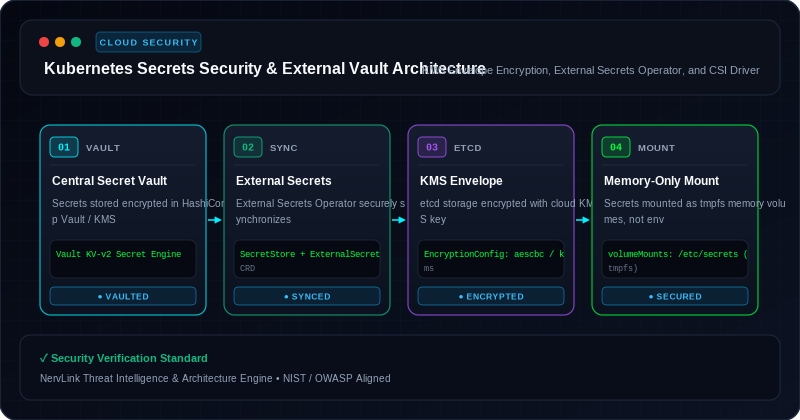
Configure API-server encryption at rest for Secret resources, and use a provider and key-management process that fits the cluster's recovery model. Encryption only helps when the keys are protected independently from the encrypted etcd data. Document key rotation, access, backup, and restoration steps, then test recovery; an encrypted backup that cannot be decrypted during an incident is not a useful recovery plan.
Protect etcd access and transport as well. Limit who can reach the datastore, secure peer communication, and protect snapshots with a separate encryption and access policy. API-server encryption does not automatically protect every copy of a secret that might exist in CI logs, shell history, a developer workstation, an observability platform, or an exported YAML file. Search these adjacent paths during design and incident response.
Keep secrets out of source and deployment output
Do not commit populated Secret manifests, rendered Helm output, Kustomize overlays, .env files, or CI artifacts containing credentials. A manifest encrypted for Git can still be mishandled if decryption keys are available to broad CI contexts. Prefer a controlled external secret provider or a narrowly scoped delivery workflow when the organization already operates one. Store only references in ordinary configuration, and grant the workload identity access to the specific secret and version it needs.
Avoid printing values while debugging. Shell tracing, verbose deployment output, exception strings, and application startup diagnostics can accidentally copy credentials into persistent logs. Redact known sensitive fields before sending logs to a vendor or shared workspace. Establish detection for secret-shaped values in repositories and CI output, while recognizing that scanners cannot find every custom credential format.
Choose a delivery mechanism deliberately
Kubernetes can expose Secret data through environment variables or mounted files. A mounted file is often easier to constrain through filesystem permissions and can be refreshed by Kubernetes after an update, but the application must notice and reload the changed value safely. Environment variables are convenient for applications, yet they may be visible in process inspection, crash reports, diagnostic bundles, or child processes. Select based on the workload and platform, then verify the behavior rather than assuming a delivery mode is automatically safe.
Mount only the required keys and only into the containers that need them. Set restrictive file modes, use a read-only mount where possible, and avoid sharing a pod among unrelated trust domains. Set automountServiceAccountToken: false for pods that do not call the Kubernetes API. A workload that can query the API with an overprivileged token may obtain more secrets than its mounted files suggest.
Rotate with overlap and a rollback plan
Rotation is a coordinated change across the secret producer, Kubernetes object or provider, application, and downstream service. A robust sequence creates a new credential, updates the application to accept it, verifies successful use, removes the old credential, and checks that no forgotten replica still depends on it. For signing keys, token formats may require a period during which validators accept both old and new keys. Set a firm end date for that overlap.
Define ownership, expected lifetime, and emergency revocation steps for each credential. Alert on unexpected reads or unusual access volume. Do not rely on changing the Secret object alone if the upstream password or API key remains valid; revoke it at the issuing service too. Record the version or identifier, not the secret value, in deployment history so operators can establish which release consumed which credential.
Review a concrete checklist
For each sensitive value, ask: Is it required in the cluster? Which exact workload needs it? Which identities can read or indirectly mount it? Is etcd encryption enabled and independently backed up? Are CI logs and source artifacts clean? Does the selected mount avoid unnecessary exposure? Can the application reload a rotated value? Can the issuing system revoke it quickly? Is access recorded and reviewed? Can a restore drill prove that recovery keys and procedures work?
Test both policy and application behavior. A negative authorization test should show that an unrelated service account cannot read the object or create a workload that mounts it. A rotation test should replace a credential in a non-production environment and confirm that the application moves to the new version without logging either value. A backup test should validate that the recovery operator can restore encrypted data using the approved key process.
Secret security is a chain. Kubernetes objects provide useful scoping and delivery controls, but they do not eliminate the need for least privilege, encryption, careful automation, rotation, and incident response. Design the whole lifecycle and verify the paths with the same rigor as the application that uses the credential.
References
- Kubernetes: Good practices for Kubernetes Secrets
- Kubernetes: Encrypting confidential data at rest
- Kubernetes: Secrets