AWS CloudTrail Organization Logging: Coverage and Integrity Checks
CloudTrail records activity in AWS accounts and can help security teams investigate changes, access patterns, and administrative actions. In a multi-account organization, an organization trail can collect events across member accounts into a centralized destination. Centralization improves coverage and reduces reliance on each account team remembering to configure logging, but only if the trail includes the right regions and event types, the destination is protected, and operators monitor delivery health.
Audit logging is not a substitute for access control or prevention. It provides evidence and detection data after or during a change. Define which events matter for threat detection, incident response, and operational troubleshooting, then verify the trail's actual coverage rather than assuming the console defaults meet every need.
Establish organization-wide scope
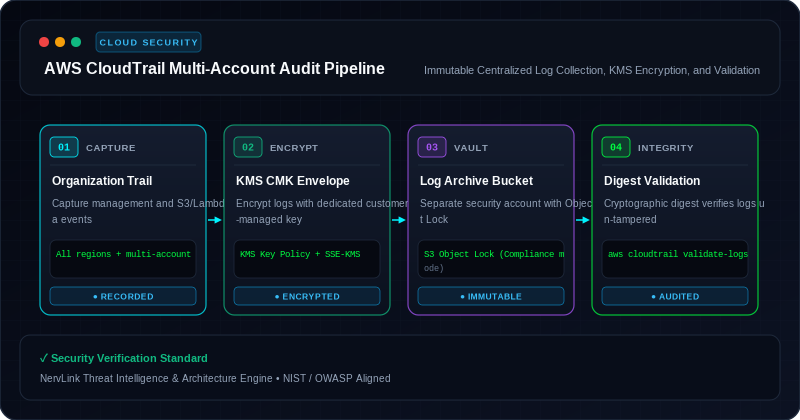
Create an organization trail from the management account or an appropriately delegated administrator. A multi-Region trail helps capture activity across enabled regions, but opt-in regions require attention: member accounts must enable a region for events to be delivered from that region. Review account creation and region enablement processes so new environments receive the expected logging coverage.
Choose management events and relevant data events based on the detection objectives. Data events can provide visibility into high-value resource operations, but they may require additional configuration and incur cost. Document exclusions and event selectors, especially for security-sensitive resources such as object storage, serverless functions, and identity configuration. Keep a coverage matrix that connects event sources to detections and response use cases.
Verify that the organization trail actually delivers logs. AWS notes that a trail can be created in member accounts even if a resource validation fails, such as an incorrect destination bucket policy or insufficient encryption permissions. Check trail status, delivery errors, and destination access after configuration changes. Alert on logging being stopped, delivery failures, changes to selectors, or policy changes that can prevent delivery.
Protect the central log destination
Use a dedicated log archive account or security boundary where practical. Restrict who can read, delete, change retention, or alter resource policies on the destination. Member accounts may be able to see the organization trail without being able to modify it, but the central S3 bucket and encryption keys still need separate protection. Apply least privilege to security analysts, incident responders, and automation roles.
Encrypt logs and protect keys with a documented recovery path. Use storage lifecycle and retention controls that match investigation and regulatory needs. Consider immutable storage or deletion protections for high-value records, and test that responders can retrieve logs during an incident. Protect the logging account from routine workload administration so a compromised application role cannot erase its own evidence.
CloudTrail log file integrity validation can deliver digest files that allow detection of modifications or deletion after delivery. Enabling this feature causes digest files to be created; it does not by itself execute validation. Schedule or perform validation and alert on failures. Preserve the digest files and any validation output with the log archive.
Make logs useful for investigation
Standardize access to the data through a query and analysis workflow. Ensure responders can search by account, region, principal, event source, event name, resource, and time range. Normalize timestamps and account identifiers. Keep records long enough to cover delayed discovery and investigation needs, but apply access and privacy controls to the stored data.
Build detections around high-impact events, such as disabling trails, changing identity trust, creating access keys, modifying network boundaries, changing encryption policy, or making storage public. Use context and change windows to reduce noise. Alert on a trail configuration change even if logging appears to continue, because a narrowed selector may silently remove the evidence needed for later investigations.
Retain enough information to attribute an action to a role session or service identity. Session names and source identity practices can improve attribution, but they are not a substitute for unique credentials and reliable role-assumption policies. Correlate CloudTrail with application logs, identity-provider events, network records, and deployment history to reconstruct the sequence of activity.
Test failure and recovery scenarios
Use a controlled test account to verify coverage for representative management and data events. Create a known test operation, wait for delivery, locate the corresponding record, and confirm that the security pipeline parses it correctly. Test a disabled region, a destination policy error, and an alert for trail modification in a safe environment. Confirm that the organization can investigate a member account even when that account's operators are unavailable.
Rehearse recovery if logs are missing or the archive is inaccessible. Identify who can restore destination access, decrypt records, reconfigure delivery, and preserve evidence. Keep emergency procedures outside the logging account itself. Document retention, costs, ownership, and escalation contacts so audit coverage remains operational through account and team changes.
Organization trail checklist
Confirm organization scope and region coverage; select management and data events intentionally; protect the archive account, bucket, and keys; monitor delivery and configuration health; enable and actually run integrity validation; build detections for control-plane changes; test query access and response workflows; and rehearse a logging outage. Review the setup when adding accounts, regions, or sensitive services.
Centralized CloudTrail logging becomes dependable when coverage is measured and integrity is checked. Create the organization trail, then treat delivery, retention, access, and alerting as production services with owners and failure monitoring. During an incident, tested log access can determine whether responders can distinguish a contained event from an ongoing compromise.
References
- AWS CloudTrail: Creating an organization trail
- AWS CloudTrail: Log file integrity validation
- AWS Organizations: CloudTrail integration