SQL Injection Prevention: Parameterized Queries and Safe Dynamic SQL
SQL injection happens when data from a caller changes the structure of a database query. The core defense is to keep query structure separate from values: write the SQL statement with parameter markers and bind values through the database driver. This allows the database to treat an input as data rather than as SQL syntax. Validation and least privilege help reduce risk, but neither replaces parameterized queries.
The vulnerability can enter through more than a web form. Values from internal APIs, message queues, files, command-line tools, and stored records can all be untrusted when they are used to construct a query. A value that was safe in one context may be unsafe in another. Review every code path that assembles SQL, including stored procedures, report builders, search filters, and administrative scripts.
Bind data values instead of concatenating strings
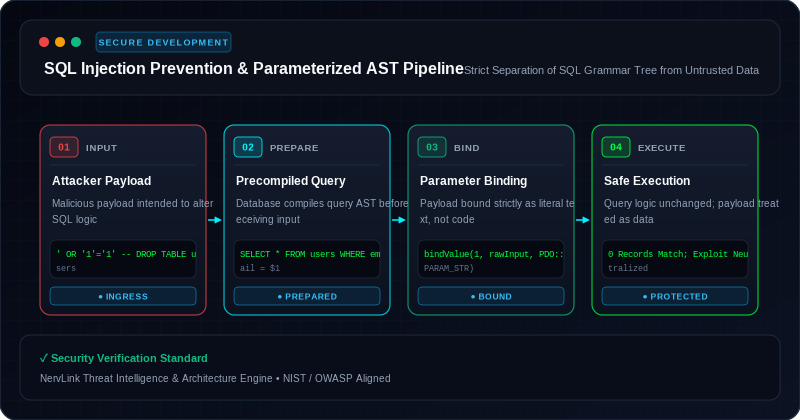
Use the parameter API provided by the language's database driver or ORM. Do not build a query with string concatenation and then “prepare” the final combined string; the structure and attacker-controlled text have already been mixed. Keep the SQL template fixed, pass values separately, and verify that the framework actually binds parameters for the operation being used.
For example, a query such as SELECT id FROM users WHERE email = ? should receive the email as a bound value. The database should not interpret quotes, comments, or operators inside the email as part of the SQL grammar. Apply the same rule to inserts, updates, deletes, and stored-procedure calls. An ORM does not automatically guarantee safety if raw query strings are built dynamically.
Do not rely on escaping as the primary defense. Escaping rules vary by database engine, configuration, and encoding. A missed edge case can change the query's meaning. Replace manual escaping with parameter binding, then add type, length, and business validation appropriate to the field.
Handle dynamic identifiers with allowlists
Parameters represent values, not SQL structure. Most database APIs cannot bind a table name, column name, sort direction, or keyword using a value marker. If a user may choose a sort field, map a small set of application-owned options to fixed SQL identifiers. Reject unknown values rather than appending them to a query. Keep the selected direction limited to known constants such as ascending or descending.
Avoid accepting raw filters or SQL fragments from clients. Build filter logic from structured fields and a controlled set of operators. If a report builder genuinely needs dynamic structure, isolate that feature, define a constrained query model, and test it separately. Quoting identifiers may protect syntax but does not decide whether the application should allow that table or column.
Review stored procedures and ORM escape hatches
Stored procedures can still be vulnerable if they concatenate parameters into dynamic SQL internally. Review procedure bodies and bind values in each dynamic statement. When identifiers must be dynamic, map them from an allowlist and use the database's identifier-quoting facility appropriately. Test the procedure with hostile input, not merely the application code that calls it.
ORM query builders can help keep values parameterized, but raw SQL methods and string-based query languages can reintroduce injection. Search for raw query APIs, string interpolation, template literals, and concatenation near database calls. Check generated SQL during development to confirm that a value is bound rather than embedded. Do not assume that validation before the ORM makes concatenation safe.
Reduce impact with database privileges
Give each application database account the minimum permissions required. A read-only service should not have schema modification or administrative privileges. Separate accounts for migrations, background jobs, reporting, and request handling where that meaningfully reduces authority. Use views to restrict access to fields or rows when supported by the database design.
Least privilege does not prevent injection, but it can limit the data and operations available if a query flaw exists. Review privileges against actual application behavior, remove unused grants, and alert on unexpected database operations. Keep database credentials out of source code and logs, and rotate them through the secret-management process.
Test query construction and error handling
Create tests that provide values containing quotes, delimiters, Unicode, comment-like sequences, and long input, then verify that the intended literal value is handled without changing query structure. Test dynamic sort choices and filters against the allowlist. Include authorization checks because a safe parameterized query can still return another user's row if the application omits ownership enforcement.
Use code review and static analysis to find query concatenation, but confirm findings in context. A clean scan is not proof that every query is safe. Dynamic testing should be authorized, scoped, and performed with test data. Avoid exposing database error messages, SQL text, schema names, or stack traces to clients; log protected diagnostics with a correlation identifier instead.
Remediation workflow
When a query is vulnerable, identify all affected call sites and the data flow that reaches them. Replace string construction with bound values, constrain dynamic identifiers, and reduce database privileges. Add a regression test using the original input path and verify the database receives the expected structure. Review adjacent queries that share a helper or coding pattern, and rotate credentials if exposure may have allowed access to them.
SQL injection prevention checklist
Bind every data value; keep SQL structure application-controlled; use allowlists for identifiers and sort options; review stored procedures and ORM raw-query calls; avoid manual escaping; apply least privilege; suppress detailed database errors from clients; and test hostile values with regression coverage. Reassess when adding report builders, filters, or user-configurable queries.
Parameterized queries are simple in principle and powerful when used consistently. The reliable design keeps data and code separate at every database boundary, with validation, authorization, and least privilege providing additional layers around that boundary.
References
- OWASP: SQL Injection Prevention Cheat Sheet
- OWASP: Query Parameterization Cheat Sheet
- OWASP Web Security Testing Guide