OS Command Injection: Safer Process Execution and Argument Handling
Command injection occurs when an application constructs an operating-system command from untrusted input and the input changes how the command is parsed or what it does. A shell interprets metacharacters, substitutions, redirects, and pipelines; a called utility may also interpret an argument as an option or a second operand. Removing shell punctuation alone does not address every argument-injection risk.
The safest approach is to avoid launching a command when a language library or API can perform the required task. Use filesystem APIs for file operations, HTTP clients for requests, and cryptographic libraries for security functions. A direct API reduces parser layers and makes it easier to constrain what the application can do.
Avoid shell command construction
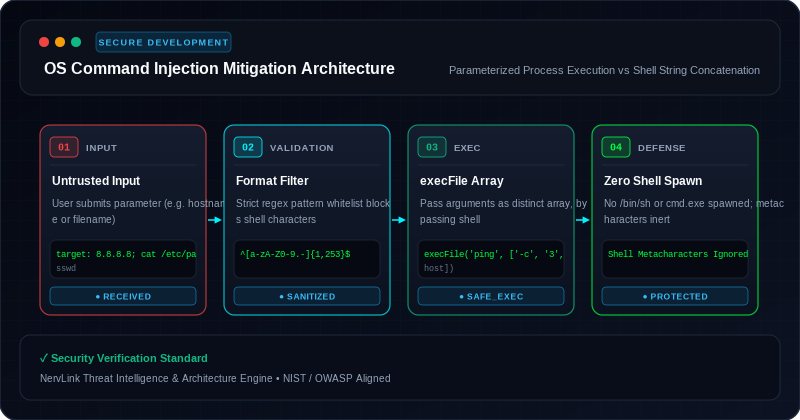
Do not concatenate user input into a shell string such as sh -c, cmd /c, or a PowerShell command. If a process is necessary, use an API that accepts an executable and a separate argument array. Use a fixed, fully qualified executable path, set a controlled working directory and environment, and do not pass untrusted data through a command interpreter.
Separate arguments prevent shell metacharacters from being interpreted by a shell, but they do not automatically make every argument safe. The target program may have its own option syntax, URL parser, path parser, or configuration language. A filename beginning with - may be interpreted as an option. Use a supported end-of-options marker when applicable, but verify the target utility's behavior and still validate the value for that command.
Fix the command and validate operands
Keep executable names and required options in application code. Map user choices to a short allowlist rather than allowing callers to select arbitrary executables or flags. Validate each operand for its purpose: a file path must remain inside an authorized directory; a URL must pass SSRF checks; a hostname must use the expected syntax; a numeric value must stay within a range. Validation should bound length and reject unexpected structures rather than trying to remove a few dangerous characters.
If the application truly must invoke a shell, constrain the design to a fixed script with no command-string interpolation and use a platform-specific safe argument mechanism. Shell quoting differs across platforms and languages. A generic escape function may protect one parsing layer while leaving a second parser vulnerable. Treat escaping as a last resort, not as the primary architecture.
Limit process authority and output
Run the application and child process with the least operating-system privileges needed. Use a dedicated account, restrict filesystem access, and avoid inheriting cloud or deployment credentials into a process that handles attacker-controlled input. Apply timeouts, resource limits, and output-size caps so a child process cannot hang indefinitely or flood memory or logs.
Capture stdout and stderr carefully. A child process may include sensitive environment data, paths, or attacker-controlled text in its output. Return a generic error to the caller and store only necessary diagnostics in protected logs. Avoid logging full commands if they contain credentials, private arguments, or personal data.
Review process launch points systematically
Search the codebase for process APIs, shell wrappers, template strings passed to execution functions, and command-building helpers. Include scripts, build pipelines, administrative tools, and test utilities; a vulnerable internal endpoint can still be reachable by a lower-privilege user. Trace input from request, file, queue, and configuration sources to the process call.
For each launch, document why a process is required, the fixed executable, allowed arguments, execution identity, working directory, timeout, and output handling. Review transitive helper libraries that wrap process execution. A higher-level wrapper may still interpolate strings or invoke a shell internally, so inspect its documented contract and version.
Test for shell and argument injection
Create deterministic tests around the exact API used by the application. Mock or replace the executable with a harmless test program and assert the executable path and argument array precisely. Try spaces, quotes, separators, newlines, leading hyphens, path traversal segments, and overlong values. Verify that rejected input causes no process launch. Add an allowed input case so protections do not silently break legitimate use.
Do not test command injection against systems outside the authorized scope. Avoid payloads that change or delete data. In development, use harmless canary arguments and a controlled child process to demonstrate whether parsing changes. Static analysis can flag risky calls, while manual review establishes whether the data reaches the command and which parser handles it.
Remediation checklist
Use a library instead of a process where possible; never interpolate untrusted values into shell text; pass a fixed executable and discrete arguments; validate each operand for its specific parser; control options and executable selection; minimize child-process privileges; bound time and output; and test that rejected input never starts a process. Review environment inheritance and logs as part of the change.
Safe process execution is about controlling both the shell and the utility that receives arguments. Removing shell syntax is only one layer. Keep authority and structure in trusted code, pass data through explicit APIs, and constrain the child process so a parsing mistake has limited impact.
References
- OWASP: OS Command Injection Defense Cheat Sheet
- MITRE CWE-78: Improper Neutralization of Special Elements used in an OS Command
- OWASP: Input Validation Cheat Sheet