Mutual TLS for Service-to-Service Identity: Design and Operations
Transport Layer Security (TLS) protects a network connection and authenticates a server to a client. Mutual TLS (mTLS) adds client-certificate authentication so the server can also verify the connecting service. This can provide strong workload identity on a network that should not trust location alone. It is most effective when certificate issuance, identity mapping, authorization, rotation, and revocation are designed as one system.
mTLS does not automatically authorize every request made by a certificate holder. A certificate may prove that a workload belongs to a service identity, while application policy still decides which operation that identity may perform. Keep authentication and authorization separate: a valid certificate should not imply unrestricted access to every API route or tenant.
Define service identities and trust boundaries
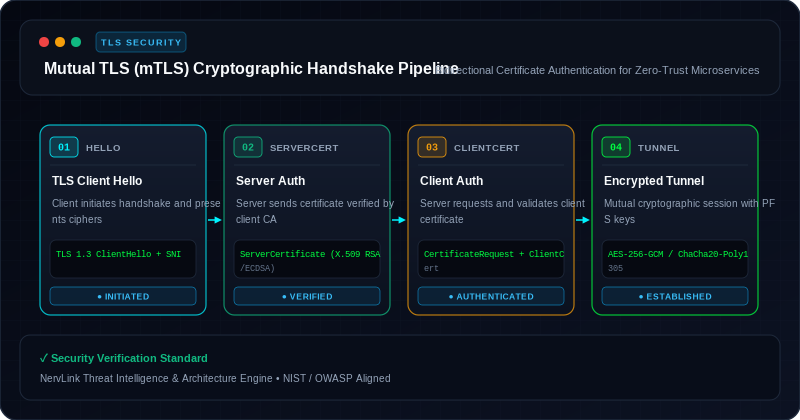
Choose a naming scheme that maps certificates to stable workload identities, such as a service name and environment. Avoid using a broad shared certificate across many services; if one workload is compromised, the shared identity expands the impact and weakens audit attribution. Decide whether identity is based on a URI subject alternative name, SPIFFE identifier, or another platform convention, and ensure every verifier checks the expected field consistently.
Identify where TLS terminates. If a load balancer or ingress proxy terminates mTLS, the backend may receive a forwarded identity header rather than the original certificate. That header is trustworthy only if clients cannot set it directly and the proxy removes or overwrites inbound copies. Protect the proxy-to-service connection and bind the asserted identity to an authenticated channel. Document each hop where identity changes form.
Operate a certificate authority carefully
Use an approved CA hierarchy with a protected signing key and a controlled issuance process. The issuing authority should verify that a workload is allowed to claim the requested identity. Restrict CA access, audit issuance, and separate production trust from development where practical. A CA that will sign arbitrary service names can mint identities that impersonate sensitive services.
Set certificate lifetimes based on operational capability. Shorter-lived certificates reduce the time a stolen credential remains useful, but only if automated renewal is reliable and monitoring catches failures. Long-lived certificates require disciplined rotation and revocation processes. Track expiration and renewal status centrally; alert early enough to fix issuance problems before they become outages.
Configure TLS and client verification deliberately
Use supported TLS versions and secure configuration appropriate to the platform. NIST SP 800-52 Rev. 2 includes TLS configuration guidance and is under review, so organizations with compliance requirements should check for current revisions and applicable policies. For TLS 1.3 deployments, follow the protocol specification and use maintained libraries rather than assembling cryptographic settings manually.
On the server, require a client certificate when the endpoint is intended only for authenticated workloads. Validate the chain to a trusted CA, certificate time validity, key usage and extended key usage as applicable, and the expected service identity. Do not accept any certificate merely because it chains to a broad public CA when the endpoint expects an internal workload. Map the verified identity to an authorization policy, and fail closed if identity parsing or policy lookup fails.
On the client, verify the server certificate and hostname. Client-certificate authentication does not replace server authentication; both sides must validate the peer. Do not disable certificate validation to address a test failure. Diagnose trust chain, name, expiry, and clock issues and repair the deployment instead.
Plan rotation, revocation, and failure behavior
Automated rotation should allow a controlled overlap between old and new certificates. Deploy trust for the new issuing chain if required, issue the replacement, confirm clients present it, and then retire the old credential. Monitor the certificate identity and serial or fingerprint without logging private key material. Keep private keys in an appropriate secret store or hardware-backed provider, and restrict their use to the intended workload.
Revocation behavior varies by protocol, library, and infrastructure. Decide how quickly a compromised certificate can be blocked, whether the verifier checks revocation data, and how trust bundle updates are distributed. Short lifetimes can complement revocation but do not replace an emergency containment procedure. Rehearse revoking a test identity and prove that the affected service loses access while unrelated services continue operating.
Set timeouts and retry behavior carefully. A CA outage or expired certificate can produce a widespread service failure if all workloads depend on synchronous issuance. Cache trust material safely, renew before expiry, and monitor handshake failures. Avoid silently falling back to unauthenticated plaintext if mTLS negotiation fails; that converts an availability issue into an authentication bypass.
Validate identity and policy end to end
Test a valid certificate, an unknown issuer, an expired certificate, a certificate with the wrong service identity, and a revoked or disabled workload. Test authorization separately by authenticating a valid but low-privilege service and confirming it cannot invoke an administrative operation. Check how the ingress, service mesh, application, and logs represent the identity so that one layer cannot forge or mislabel it.
Use observability that records the authenticated identity, destination service, decision, and request correlation ID without exposing sensitive credential material. Alert on repeated failures, unexpected identities, sudden issuance volume, and use of a certificate from an unusual environment. Keep privacy and retention requirements in mind when logging client identities.
Deployment checklist
Define unique service identities, protect the CA, validate both peers, bind certificates to authorization rules, automate renewal, monitor expiry, rehearse revocation, secure identity propagation across proxies, and ensure failure never downgrades to unauthenticated transport. Keep separate trust where environments have different risk and access needs. Review the design whenever a new proxy or service boundary is added.
mTLS is a useful building block for service identity, especially when networks are dynamic and workload locations change. Its real security comes from trustworthy issuance, precise identity checks, least-privilege authorization, and operationally tested rotation. Treat certificates as managed credentials with an owner and lifecycle, not as a one-time TLS configuration option.
References
- RFC 8446: The Transport Layer Security Protocol Version 1.3
- NIST SP 800-52 Rev. 2: TLS Implementation Guidelines
- RFC 8705: OAuth 2.0 Mutual-TLS Client Authentication