DNSSEC for Domain Owners: Signing, DS Records, and Validation Checks
The Domain Name System Security Extensions (DNSSEC) add origin authentication and data integrity to DNS responses through digital signatures and a chain of trust. A validating resolver can detect when signed DNS data does not match the expected cryptographic records. DNSSEC does not encrypt DNS queries, hide which names are requested, or protect a connection to the website after name resolution. It addresses a specific DNS integrity problem and should be described within that scope.
For a domain owner, enabling DNSSEC requires coordination between the authoritative DNS provider and the registrar. The zone is signed by the DNS operator, while the parent zone publishes a Delegation Signer (DS) record that links the child zone's signing key into the DNS hierarchy. A mismatch or stale DS record can make validating resolvers treat the domain as bogus and fail to resolve it.
Understand the chain of trust
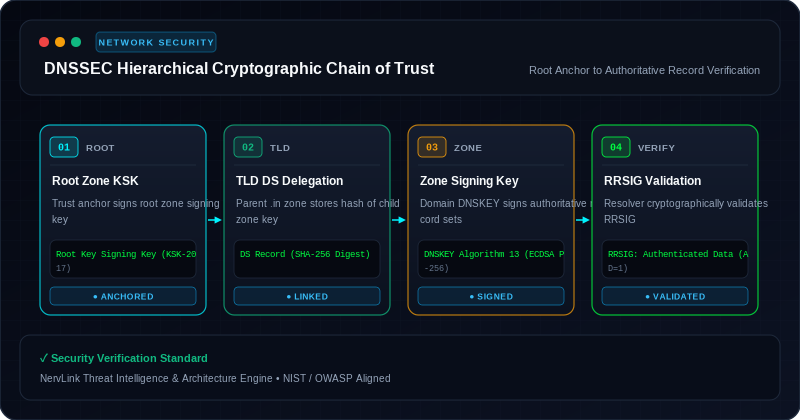
DNSSEC uses DNSKEY records for public keys and RRSIG records for signatures over DNS record sets. A parent zone publishes a DS record derived from a key in the child zone. A validating resolver follows trust from its configured root trust anchor through parent delegations to the requested name. The resolver checks signatures, key relationships, and validity periods according to the protocol.
This means that zone signing alone does not complete deployment. The parent-side DS record must correspond to the key arrangement managed by the DNS provider, and the resolver must validate the chain. The DNS host usually supplies the DS values for the registrar to publish. Do not invent or manually recalculate the values unless the provider's documented process requires it.
Coordinate provider and registrar changes
Before enabling DNSSEC, confirm that the authoritative DNS provider supports signing and publishes the required DNSKEY and RRSIG records. Determine how the provider handles key rollover, algorithm selection, key storage, signing failures, and emergency disablement. Verify that the registrar accepts the DS fields and that the domain's registry supports the chosen parameters.
Follow the provider's sequence exactly. A safe process commonly enables signing at the DNS operator, confirms the signed zone is visible from authoritative servers, then adds the matching DS at the registrar. However, provider workflows can differ, especially during migration between DNS operators or when pre-publishing keys. Coordinate both sides to avoid a period where the parent DS points to keys the child does not serve.
If moving nameservers, plan DNSSEC state as part of the cutover. The old provider may own current signing keys while the new provider has a different key set. A parent DS that remains published after the old signing chain disappears can break validation. Schedule changes with rollback steps and allow for TTLs and registry propagation.
Validate from multiple resolver perspectives
Check authoritative answers for DNSKEY, DS-related chain, and RRSIG records using supported DNS diagnostic tools. Then query through at least one validating recursive resolver and one independent DNSSEC test service. A response that appears correct from a non-validating resolver does not prove that the chain validates. Check each relevant record set, including A, AAAA, MX, and TXT records, because signing applies to sets in the zone.
Monitor expiration times and signature refresh behavior. If the signing operator stops producing current signatures, validating resolvers can reject data even though the records remain visible. Monitor DNS service status, key rollover events, and validation results after provider changes. Include DNSSEC state in domain-transfer and disaster-recovery inventories.
Plan key rollover and incident handling
Key rollover should preserve a valid chain throughout the transition. Use the DNS operator's documented process for introducing new keys, updating the DS set where required, and retiring old keys. Avoid changing registrar DS records manually without understanding which key is active and when caches will expire. Test the rollover in a low-risk domain or staging setup when possible.
If a domain becomes DNSSEC-bogus, determine whether the DS is stale, the active key is missing, signatures expired, an algorithm is unsupported, or a provider is not serving the signed zone correctly. Compare authoritative data with the parent delegation and recent change history. Use the DNS operator and registrar support paths quickly; changing unrelated A or MX records may not repair a broken trust chain.
Disabling DNSSEC can restore resolution in some failure situations but removes validation protection and should be a controlled response. Record who approved the change, preserve the broken state for diagnosis, and re-enable signing with a verified chain after repair. For high-value services, prepare contacts and emergency procedures before an outage.
Know the limitations
DNSSEC provides authentication and integrity for DNS data, not confidentiality. Queries may still be visible to network observers unless a separate encrypted DNS transport is used. DNSSEC also does not establish whether a signed address is safe, prevent phishing on a legitimate domain, secure application protocols, or stop a compromised authoritative account from publishing malicious records and signing them.
Pair DNSSEC with registrar account security, multi-factor authentication, registry locks where appropriate, access logging, change alerts, and secure transport such as HTTPS. Protect the account that controls DS records because that administrative boundary is part of the chain's security. Keep recovery contacts and domain ownership information current.
Domain-owner checklist
Confirm provider support and key procedures; obtain DS values from the authoritative DNS operator; coordinate the registrar change; verify authoritative signatures and validating resolver behavior; monitor signatures and provider status; plan rollovers and nameserver migrations; and document the DNSSEC-bogus response path. Do not rely only on a dashboard toggle or one recursive lookup.
DNSSEC can make forged or altered DNS answers detectable when the validation chain is correctly deployed. Its operational dependency on both child-zone signing and parent-side delegation makes careful change management essential. Validate the complete chain after activation, migration, and rollover so that the protection does not become an availability failure.
References
- IETF RFC 9364: DNS Security Extensions (DNSSEC)
- IETF RFC 4035: DNSSEC Protocol Modifications
- ICANN: DNSSEC—What Is It and Why Is It Important?