Cybersecurity Incident Response: A First-Hour Checklist for Small Teams
The first hour of a suspected security incident is often spent trying to decide whether the alert is real, who owns the affected system, and whether someone should shut it down. A written incident plan helps a small team make those decisions without improvising under pressure. It should not force every alert into a “breach” label or prescribe destructive containment before responders understand the business impact. The aim is to establish a coordinated, evidence-preserving response and reduce avoidable harm.
This checklist is for defensive response on systems an organization operates. It is a starting framework, not legal advice or a substitute for a regulator, insurer, incident-response provider, or law-enforcement instruction. Contact those parties according to the organization's plan, especially when regulated data, safety, or active extortion is involved.
Minutes 0 to 10: establish control and capture facts
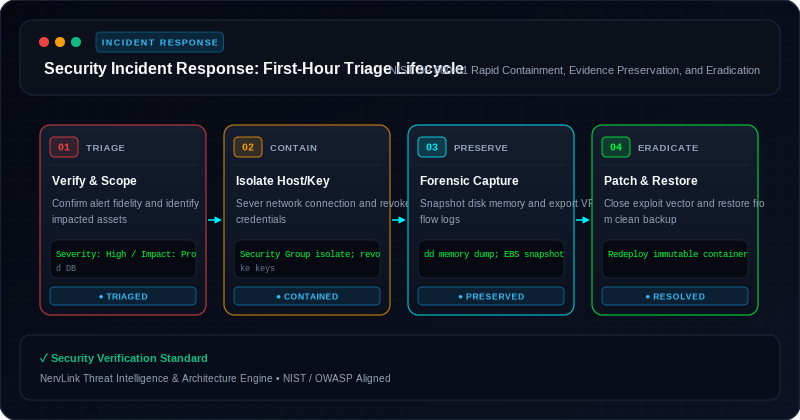
Assign one incident lead, one technical lead, and one person responsible for the decision log. In a small team these may be the same people at first, but write down who is performing each role. Open a restricted incident channel using a communication method that does not depend entirely on a possibly compromised identity provider or endpoint. Verify participants through a known contact path. Avoid posting suspected credentials, personal data, or full malware samples in a broad chat.
Record the initial facts with timestamps and time zone: who reported the issue, alert source, affected account or asset, observed behavior, first and most recent known activity, and actions already taken. Preserve the original alert and relevant logs. Mark estimates as estimates and facts as facts. Keep a running timeline with the person and system responsible for each action. This prevents later confusion about whether a restart, password reset, or rule change happened before or after an observation.
If there is immediate risk to people, safety-critical systems, or continuing data destruction, use the emergency decision path in the plan and contact the appropriate owner. Do not wait to complete a perfect evidence packet before acting to prevent imminent harm.
Minutes 10 to 20: confirm scope without expanding access
Ask the reporter to describe what they observed, not to perform extra exploration. Identify affected business services, accounts, endpoints, cloud projects, vendors, and data classes. Check whether the alert is corroborated by an independent source such as identity logs, endpoint telemetry, application audit records, or a service provider notification. Record the source, query window, and any gap in available logs.
Preserve evidence using approved tools and documented procedures. Export relevant cloud and identity audit logs before retention windows expire. Keep original files immutable where possible, calculate hashes for collected artifacts, and note collection time and collector. Do not run an untrusted file on a responder's workstation or upload sensitive evidence to a public scanner. If forensic acquisition is needed, use trained responders and the organization's chain-of-custody process.
Set a working severity based on observed impact, affected services, privilege level, data sensitivity, and whether activity is ongoing. Label it provisional and record what evidence would change the assessment. Severity is a coordination aid, not proof that a particular legal threshold has been met.
Minutes 20 to 40: choose proportionate containment
Containment should reduce attacker access while preserving the evidence and availability needed to understand the event. Options depend on the system and authority of the responders. Examples include revoking a confirmed compromised session, temporarily disabling a compromised account, isolating an endpoint through the endpoint-management console, blocking a verified malicious indicator at a controlled boundary, or disabling a vulnerable feature behind a tested flag.
Before a change, identify the system owner, expected side effect, rollback path, and evidence that should be collected first. A broad IP block may disrupt customers or incident responders. Shutting down a server can destroy volatile evidence and interrupt critical services. Rotating a secret may be necessary, but identify all dependent workloads and the order in which credentials must be replaced. When compromise of an administrator account is suspected, do not rely on that account to authorize or communicate the response.
Do not “clean up” systems or delete suspicious messages before evidence is preserved. Avoid running ad hoc remediation commands copied from an unverified source. Use a known-good administrative device and verified control plane when credentials or endpoints may be compromised.
Minutes 40 to 60: communicate, assign, and schedule the next update
Notify the service owner, security lead, privacy/legal contact, and communications contact according to the incident plan. Use the facts already recorded and clearly separate confirmed evidence from hypotheses. Do not speculate publicly about attribution or scope. If a vendor or cloud provider must be engaged, use a support account and contact route that the organization can verify.
Create action items with one owner, one deadline, and one expected artifact each. Examples include “export identity sign-in logs for 09:00-11:00 UTC,” “confirm whether the affected API token had production scope,” and “identify the last known-good backup and restore test.” Set the next briefing time even if there is no new conclusion. Update stakeholders when scope or containment materially changes.
At the one-hour mark, the incident log should include: incident lead, affected services, provisional severity, known facts, important unknowns, preserved evidence and its location, containment actions and approvals, notification decisions, owners, and next update time. This is a decision record, not a polished report.
Prepare these items before an incident
- A current inventory of critical services, owners, dependencies, and recovery objectives.
- Emergency contacts for identity, cloud, network, endpoint, legal, privacy, insurers, and vendors.
- A secure communication channel and a way to verify responders if primary identity is unavailable.
- Log retention and export procedures for identity, endpoint, cloud control plane, DNS, email, and applications.
- Authority boundaries for account disablement, endpoint isolation, traffic blocks, and service shutdown.
- Tested backups, credential rotation procedures, and restore runbooks with named owners.
- A short incident log template and evidence-handling instructions.
Keep the plan small enough to use. Run a tabletop exercise with a realistic scenario, such as a compromised administrator token or a suspicious deployment, and record where responders could not find a system owner, log source, or approval. Fix those gaps. A document that has never been exercised is an assumption, not an operational capability.
After stabilization
Continue monitoring for recurring access, persistence, and missed affected assets. Determine the entry point and scope using evidence and preserve uncertainty where the evidence is incomplete. Restore only from trusted sources after the relevant risks are addressed. Track remediation and verify that the control works after deployment. Conduct a blameless review focused on conditions that made detection, containment, or recovery harder. Update the plan, logging, and exercises based on specific findings.
NIST SP 800-61 Revision 3, published in April 2025, integrates incident response recommendations into cybersecurity risk management and the NIST Cybersecurity Framework 2.0. CISA's playbooks offer a structured federal response reference. Organizations should adapt those resources to their own systems, obligations, and available responders rather than treating a generic checklist as a complete plan.
References
- NIST SP 800-61 Revision 3: Incident Response Recommendations
- CISA Federal Incident and Vulnerability Response Playbooks
- NIST Cybersecurity Framework
Editorial status: Owner authorized publication without an individual reviewer. This checklist is general guidance; follow your organization's incident, legal, and safety procedures.