Security Logging Without Leaking Secrets or Losing Evidence
Logs help defenders understand what happened, when it happened, and which identity or system performed an action. They also create a second store of sensitive data. A log entry may contain access tokens, personal information, internal paths, or attacker-controlled text. A sound logging design balances investigation value with confidentiality, integrity, availability, and retention requirements.
Begin with the questions responders must answer. Which authentication events matter? Can the team determine whether a user accessed a record, whether an administrator changed a role, or whether a deployment altered a security setting? Define event names and fields so that application, identity, infrastructure, and cloud logs can be correlated. Avoid collecting everything by default; excess data increases cost and exposure while making useful evidence harder to find.
Capture events with clear context
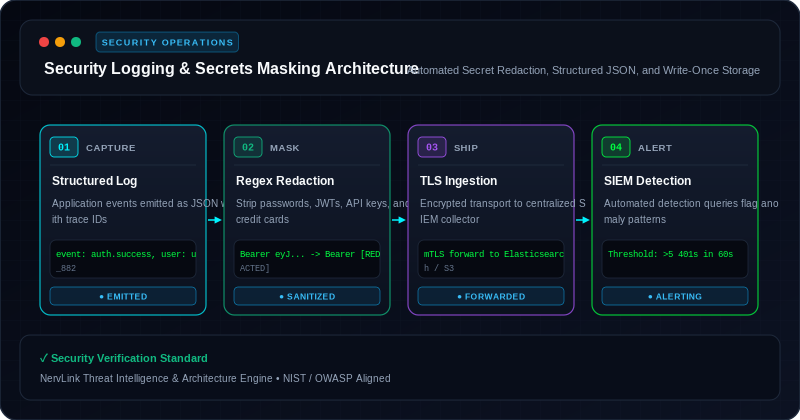
Record security-relevant successes and failures: authentication, authorization denials, session changes, privilege elevation, administrative actions, sensitive exports, configuration changes, and unusual business workflows. Include a reliable timestamp, event type, actor or service identity, target, outcome, source context, and correlation identifier. Use structured formats such as JSON so fields can be searched consistently.
Normalize time and identity across systems. Use synchronized clocks and a consistent identity mapping for users, roles, and service accounts. Record the request or trace ID that links a client action to downstream services, but avoid making a user-supplied value the sole identifier. If an action occurs through an assumed role, retain enough session context to identify the originating workload or operator.
Do not log secrets or full request bodies by default. Redact passwords, API keys, session cookies, authorization headers, and private key material before data reaches application logs, reverse proxies, tracing systems, analytics platforms, or error reporting. Test redaction with synthetic values across the entire pipeline. Masking at the final dashboard does not help if raw secrets were already written to an upstream file.
Treat untrusted input as hostile log data
Attackers can include newline characters, control codes, or misleading delimiters in usernames, URLs, headers, and file names. If logs are unstructured, such input can forge apparent records or interfere with parsers. Use structured encoders that safely escape values, set size limits, and normalize fields before ingestion. Keep message templates constant instead of constructing log strings with raw user data.
Do not use logs as an uncontrolled data sink. Avoid recording arbitrary object serialization, stack traces containing secrets, or verbose debug output in production. Sanitize errors at the boundary and preserve detailed diagnostics in a protected channel with restricted access. Ensure security logs cannot be reached from a public web directory or queried by ordinary users without authorization.
Protect log integrity and availability
Restrict who can create, read, modify, and delete logs. Application processes generally need to write but should not be able to erase their historical records. Forward critical events to a centralized system or separate account so compromise of one host does not remove all evidence. Use tamper detection, immutable retention, or read-only copies where the risk and platform support justify them.
Protect the logging pipeline itself. Apply authentication and encryption in transit, monitor collector health, and alert when expected sources stop reporting. A silent gap can be more significant than a noisy alert. Bound event size and ingestion rate to prevent log flooding from exhausting disk or service quotas. Define backpressure behavior so that an overloaded sink does not unexpectedly expose data or crash a critical application.
Set retention, access, and privacy rules
Define retention by investigation needs, operational requirements, privacy obligations, and contractual commitments. Keep data long enough to support delayed detection, but do not retain personal data indefinitely without a purpose. Separate high-sensitivity security events from routine diagnostics when access needs differ. Log access should itself be logged and reviewed.
Provide responders with rapid access to the right records during an incident, including after hours. Document search methods, query patterns, data owners, and escalation paths. Periodically test that the expected logs exist and can be retrieved. A retention policy that has not been validated against actual platform lifecycle settings may not match reality.
Build useful alerts on top of reliable events
Alert on events that represent meaningful change or behavior: repeated failures, privilege changes, use of emergency accounts, new credential creation, security-policy edits, large exports, or suspicious sequences. Correlate related records to reduce isolated false alarms. Give alerts an owner and response action. Use severity based on impact and confidence, not solely on the event name.
Review false positives and missed cases with analysts and developers. A noisy detection that is repeatedly ignored is not effective. Create safe test events to prove that instrumentation and alert rules work from source to analyst view. Keep these tests non-sensitive and label them so they do not trigger incident escalation unnecessarily.
Logging design checklist
List the investigation questions; standardize event schema and identity; synchronize time; redact secrets before collection; escape untrusted input; protect writes, reads, and deletion separately; monitor source and pipeline health; set purposeful retention; log access to sensitive records; and test alerts end to end. Revisit the design when data flows, authentication, or service ownership changes.
Good security logging is intentional, privacy-aware, and resilient to compromise. Capture enough context to reconstruct important actions, protect the records from alteration, and exclude credentials that could become a second incident. Build and test the pipeline as part of the application rather than treating logs as a byproduct of debugging.