Threat Modeling Workshop: Turn a Data-Flow Diagram into Security Work
Threat modeling is a structured way to examine how a system could be misused and decide which risks deserve engineering work. It is most useful when the people building the system can still change its design. A workshop that produces a diagram and a list of dramatic attack stories but no owners, requirements, or follow-up is documentation, not an effective security control.
The scope can be a new feature, a service boundary, a deployment design, or a change that introduces sensitive data. Keep it small enough for the team to understand in one session, while recording how it relates to the wider product. State what is in scope, what is outside the model, which assumptions are being made, and who owns the decisions.
Prepare the system model
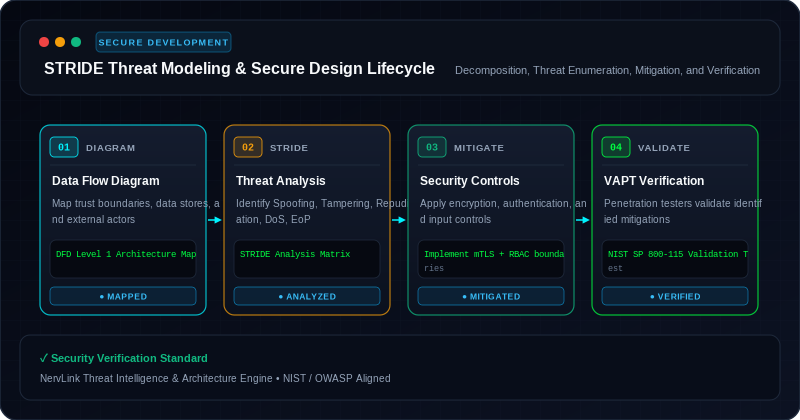
Invite people who know the architecture, application behavior, infrastructure, identity system, and business process. The team does not need to be large; it needs enough context to identify where data moves and which controls are real. Bring a current architecture diagram, repository or deployment references, data classifications, trust assumptions, and known abuse cases.
Draw the important processes, data stores, external entities, and flows. Mark trust boundaries where identity, network, administrative control, or data ownership changes. Add protocols and authentication relationships when known. The purpose is not visual polish; the model should help participants ask where untrusted input enters, where authorization is checked, where secrets are stored, and what happens when a component is unavailable or compromised.
Validate the drawing with engineers who operate the system. A stale diagram is worse than a simple diagram that accurately represents reality. If the group disagrees about whether a service is public, which identity it uses, or whether a flow crosses a tenant boundary, record that uncertainty as a question to resolve rather than silently choosing the safer-looking answer.
Identify threats with focused prompts
Use a method such as STRIDE as a prompt list, not as a requirement to invent one threat in each category for every box. Ask whether an attacker could impersonate an identity, alter data or configuration, hide an action, access information, exhaust resources, or gain authority. Tie each threat to a component or data flow, a precondition, and an unwanted outcome.
Look beyond technical protocol attacks. Consider abuse of legitimate features, compromised dependencies, insider access, stolen credentials, unsafe defaults, cross-tenant mistakes, and failures in deployment or recovery. Ask how the system behaves when an external API returns unexpected data, an authorization service is unavailable, or an operator must restore from a backup. Privacy threats may require additional methods because conventional security categories do not capture every harmful use of personal data.
Avoid treating a threat list as a prediction that an attack will happen. It is a structured exploration of plausible failure modes. Use evidence such as incident history, penetration-test findings, architecture changes, and security advisories to focus the session. For high-risk systems, conduct deeper analysis with specialists rather than relying on a short workshop alone.
Rank and decide a response
Prioritize threats using the business context: attacker capability, exposure, ease of exploitation, affected assets, likely impact, existing controls, and remediation cost. Numeric scores can help compare issues, but a score is not a substitute for discussion. Record uncertainty and avoid false precision when likelihood data is weak.
For each meaningful threat, select a response: mitigate it, remove the feature or path that enables it, transfer some consequences through a defined arrangement, or accept the risk with an accountable owner. Risk transfer does not make an attack less likely and should not erase the organization's responsibility for its controls. Accepted risks need scope, rationale, expiry or review date, and approval appropriate to impact.
Turn mitigations into testable work. “Improve authorization” is too vague. A stronger requirement might specify that every object read checks tenant ownership server-side, then define tests for valid access, cross-tenant denial, missing identifiers, and a user with a lower privilege level. Link requirements to backlog issues, threat records, design decisions, or security tests so that the work remains actionable after the workshop.
Revisit the model as the system changes
Threat models become stale when the product adds an API, moves a trust boundary, changes identity providers, introduces a new data class, or modifies deployment authority. Define a trigger for review as part of architecture and pull-request practices. A short delta review can update the affected portion instead of repeating a full analysis every time.
Keep a record of decisions, owners, open questions, model version, and the release or architecture state it describes. Store it with the project documentation and restrict sensitive details according to policy. Do not include exploit secrets that could create unnecessary risk in broadly accessible tickets; describe the issue enough to implement the control safely.
Workshop agenda and follow-up
A practical session can spend time on scope and assumptions, system decomposition, threat discovery, risk prioritization, and action assignment. End by reading back the highest-priority items and confirming who owns each one. Afterward, validate unresolved architecture questions, create linked engineering work, and schedule a review of accepted risks. Measure completion of mitigations and changes in residual risk, not the number of diagrams produced.
Use the resulting model to guide design review, test planning, and incident preparation. Security tests should exercise the threat assumptions: authorization boundaries, malformed input, resource limits, identity transitions, and failure behavior. If tests reveal a different architecture than the drawing suggests, update the model and the control plan.
A useful threat model is operational
Good threat modeling is repeatable, proportionate, and connected to engineering decisions. It helps a team see trust boundaries, anticipate meaningful abuse, choose controls, and validate that those controls work. Start with a clear system model, make assumptions visible, rank issues in context, and assign concrete actions. Revisit the work when the system or threat landscape changes.