Test CORS Origin Policies Without Confusing Them With Authentication
Cross-Origin Resource Sharing (CORS) controls whether browser JavaScript may read certain responses from a different origin. It is a browser protocol layered on top of the same-origin policy. CORS does not authenticate a caller, authorize a user, or prevent every cross-site request from reaching a server. A secure API still needs authentication, authorization, input validation, CSRF defenses where applicable, and appropriate rate limits.
This distinction explains a common diagnostic surprise: a request can succeed in curl or Postman while a browser reports a CORS error. Those tools do not enforce browser CORS rules. The server may have received the request and performed an action even though the browser prevented the page from reading the response. Treat a CORS failure as a browser access-control symptom, not proof that the endpoint rejected the request.
Define allowed origins precisely
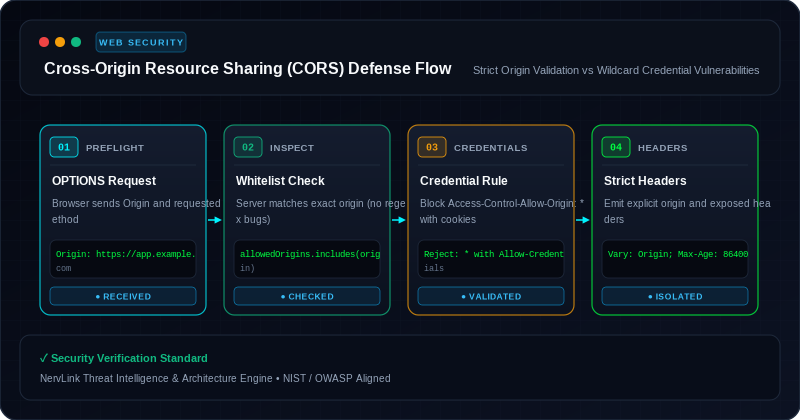
An origin is the scheme, host, and port tuple. https://app.example.com and http://app.example.com are different origins, as are https://app.example.com and https://admin.example.com. A CORS allowlist should compare the parsed Origin value against exact configured origins. Avoid substring checks such as “ends with example.com” unless the implementation correctly handles label boundaries and the full origin tuple.
Do not reflect any Origin request header into Access-Control-Allow-Origin. That effectively tells the browser to allow every requesting site. For a small product, configure a short list of known frontend origins in environment-specific settings. Reject or omit CORS permission for every other origin. If a server returns a specific origin dynamically, include Vary: Origin so caches do not reuse a response authorized for a different origin.
The wildcard Access-Control-Allow-Origin: * cannot be combined with credentialed browser access. When cookies or browser-managed credentials are required, the server must return the exact permitted origin and Access-Control-Allow-Credentials: true. A broad credentialed policy is dangerous because it may expose user-specific responses to an untrusted web page. Restrict credentialed CORS to origins that actually need it and keep authentication and authorization checks on the server.
Understand preflight requests
For some cross-origin requests, the browser sends an OPTIONS preflight before the actual method. The preflight asks whether the origin, method, and requested headers are allowed. The server should answer only the required methods and headers for an allowed origin. Do not globally allow every method and header to avoid debugging one client. OPTIONS should not create business side effects.
A simple GET may be sent without a preflight, so a preflight-only test does not cover all cross-origin behavior. Conversely, a browser may block access to a response after sending a request. Test the actual route's side-effect behavior as well as the CORS headers. CORS is not a substitute for a CSRF token or origin validation on state-changing cookie-authenticated requests.
Exercise the policy with controlled requests
Use a known allowed origin, a hostile unrelated origin, a lookalike subdomain, and a missing Origin header. In a controlled test environment, inspect response headers for both normal requests and preflights:
curl -i -H 'Origin: https://app.example.com' https://api.example.com/v1/profile
curl -i -H 'Origin: https://evil.example' https://api.example.com/v1/profile
curl -i -X OPTIONS \
  -H 'Origin: https://app.example.com' \
  -H 'Access-Control-Request-Method: POST' \
  -H 'Access-Control-Request-Headers: content-type,authorization' \
  https://api.example.com/v1/profile
These requests help inspect server behavior; curl does not enforce CORS. Follow them with a browser test from pages served at allowed and disallowed origins. Confirm that an allowed origin can read only the intended response and a disallowed origin does not receive permissive CORS headers. For state-changing routes, separately assert that unauthenticated or forged requests do not alter data.
When credentials are used, check cookies' SameSite, Secure, and HttpOnly properties and test CSRF protections. Cross-origin and cross-site are related but not identical concepts, especially with subdomains and browser cookie rules. Do not weaken cookie policy just to make CORS work. Prefer same-origin deployment or a backend-for-frontend when that reduces cross-origin complexity.
Common misconfigurations and their tests
- Origin reflection: send an untrusted Origin and verify it is not echoed.
- Unsafe suffix matching: test
example.com.attacker.invalidand an unrelated lookalike host. - Wildcard with credentials: ensure production never returns
*together with credential permission. - Overbroad methods: test that a method not needed by the app is not allowed.
- Header wildcard assumptions: explicitly test each required request header, including authorization and content type.
- Missing cache variance: test through the configured CDN and confirm
Vary: Originwhere the response varies by origin. - Preflight side effects: confirm repeated OPTIONS requests do not enqueue work or mutate state.
- CORS as authorization: call the API directly with an unauthorized account and ensure access is still denied.
Record the endpoint, response headers, requesting origin, browser version, and whether the request itself reached the server. Redact cookies and tokens from traces. A proxy can alter headers, so compare the origin service response with the edge response if behavior differs.
A review checklist
- Store exact allowed origins by environment and compare the full scheme, host, and port.
- Return only the required methods and headers for allowed origins.
- Never reflect arbitrary Origin values or assume CORS is authentication.
- Use exact origins for credentialed requests, with a clear need for browser credentials.
- Add
Vary: Originwhen the allowed response changes by request origin. - Test browser-readable responses, server-side side effects, preflights, and direct API calls.
- Keep CSRF, authorization, and cookie controls independent from CORS.
The Fetch Standard defines the CORS protocol used by browsers. OWASP's CSRF guidance explains why browser cross-origin behavior and request-forgery protections need separate treatment. For debugging, compare browser network traces with direct HTTP requests, but make authorization decisions only on the server.
References
- WHATWG Fetch Standard: CORS protocol
- OWASP Cross-Site Request Forgery Prevention Cheat Sheet
- MDN: Cross-Origin Resource Sharing
Editorial status: Owner authorized publication without an individual reviewer. Examples target controlled or owned APIs.