CISA KEV Prioritization: Turn Exploited CVEs into an Asset Response Queue
The CISA Known Exploited Vulnerabilities (KEV) catalog is a practical signal for remediation planning because it records vulnerabilities for which exploitation has been observed. It answers a different question from a severity score: not only how serious a weakness could be, but whether attackers are already using it. That signal is valuable, but a catalog match alone does not tell a team which of its systems are exposed, what business service is at risk, or whether an available mitigation is safe to deploy.
The useful unit of work is therefore not a spreadsheet row labeled “KEV.” It is a verified relationship between a CVE, an affected product and version, an asset, an exposure path, an accountable owner, and a response decision. This guide turns that relationship into a repeatable defensive workflow. CISA's binding deadlines apply to the federal civilian agencies named by its directives; other organizations can use the catalog as a prioritization input without claiming those deadlines are legally binding on them.
Build a trustworthy asset-to-CVE join
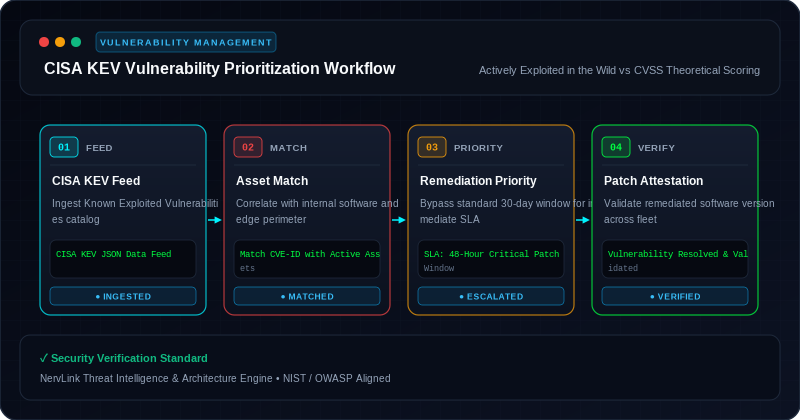
Start with inventory data that can identify software precisely: vendor, product, edition, version, deployment location, and whether the asset is reachable from the public internet or a less-trusted network. A hostname alone is not enough. Cloud images, containers, appliances, end-of-life branches, and vendor backports can make a simple version comparison wrong. Record the evidence source for each version, such as an authenticated scanner, package manager, cloud inventory, or vendor console, and the date it was observed.
Normalize CVE identifiers and product names before joining data. Preserve the original scanner finding alongside the normalized record so analysts can trace a match back to its evidence. Treat uncertain matches as “needs validation,” rather than silently upgrading them to confirmed exposure. A false positive can consume an emergency patch window; a false negative can leave an internet-facing service exposed.
Fetch the catalog from CISA's official page or its published machine-readable feed, validate the response schema, record the catalog release date, and retain the previous snapshot. A failed download must not replace a good local snapshot with an empty list. Compare catalog versions and entries as part of routine operations, but do not assume that absence from KEV means a CVE is not exploitable. KEV is a curated exploited set, not a complete vulnerability database.
Rank work using exploitation and context
Use KEV membership as a strong escalation signal, then enrich it with exposure, asset criticality, exploit prerequisites, compensating controls, and operational consequence. FIRST's Exploit Prediction Scoring System (EPSS) estimates the probability of exploitation activity in the next 30 days; it is useful context, not proof that a particular organization is under attack. CVSS describes technical severity. Neither score should erase the direct evidence conveyed by KEV membership.
A workable queue might distinguish: confirmed KEV on an internet-facing asset; confirmed KEV on an internal high-value asset; suspected product match requiring rapid validation; and no affected asset found. Give each record an owner and a decision date. If a vendor advisory says a vulnerable feature is disabled by default, verify that configuration on the real asset rather than assuming the default remains in place. Capture the evidence and reviewer so later teams do not repeat the same investigation.
A repeatable daily triage procedure
- Record the catalog version and retrieval time. Alert only when a new entry appears or an existing entry changes in a way relevant to your policy.
- Match each new CVE against software inventories and scanner findings. Include cloud instances, images waiting for deployment, and externally managed appliances in scope.
- Validate likely matches against the vendor advisory. Confirm affected and fixed versions, supported workarounds, reboot requirements, and any configuration-dependent exposure.
- Check asset reachability, service importance, known compensating controls, and evidence of attempted exploitation in your own logs.
- Assign patch, mitigation, isolation, or documented exception actions with owners and deadlines based on risk and applicable policy.
- Re-scan or query authoritative inventory after the change. Close the finding only when the fixed version or mitigation is evidenced, not merely when a ticket is marked complete.
For automation, keep the update pipeline idempotent. A useful record includes the CVE, product, asset identifier, version evidence, KEV date-added value, remediation guidance, EPSS snapshot timestamp if used, owner, response state, and verification timestamp. Do not copy a catalog's federal due date into a private organization's SLA without explaining that the organization adopted it as an internal target.
Patch safely without losing urgency
Urgency does not remove change control. For a production service, identify a tested package or vendor mitigation, take a recoverable backup where appropriate, stage the change on a representative system, and define a rollback condition. If a patch cannot be applied immediately, reduce reachability or disable the vulnerable feature where the vendor confirms that is effective. Add monitoring for the affected service and make the exception time-bound with a named risk owner.
Do not apply an unrelated exploit proof-of-concept to production as a validation shortcut. Prefer authenticated version checks, vendor-provided checks, configuration inspection, and benign detection methods. If a suspected compromise is found, stop treating the issue as patch management alone: preserve relevant logs and engage the incident response process before rebuilding or deleting evidence.
Measure whether the process works
Track time from catalog addition to asset match, time to mitigation, overdue confirmed exposures, inventory coverage, and the share of closures verified by a fresh scan. Separate “no affected asset” from “not checked”; the latter is an inventory problem. Review exceptions weekly and look for assets repeatedly missed by scanners or teams that cannot patch within their normal window.
The most useful dashboard does not reward teams for closing tickets quickly. It reveals where exposure persists, where asset data is unreliable, and whether remediation is reducing risk. Review the ranking model after changes to the technology estate and record why priorities were changed. For regulated environments, map the workflow to the organization's own policy and applicable obligations rather than treating one federal directive as universal law.
Safe use and maintenance note
Use this workflow only against assets your organization is authorized to inventory and manage. Catalog matching is defensive triage, not an instruction to probe third-party systems. The examples describe a process and should be adapted to local change, incident, and regulatory requirements. Last updated: 2026-11-09. Change log: Initial publication; workflow and source links reviewed for this release.